Skip to content

Blog#

92% of Nonprofits Use AI. Only Half Have a Policy. Here's What One Foundation Built.

Your staff is already using AI. You probably know that. What you might not know is which tools, on which data, with what guardrails.

The 2026 Nonprofit AI Adoption Report put a number on it: 92% of nonprofits are using AI in some capacity. But 47% have no governance policy at all. And 81% are using AI individually, no shared workflows, no documentation, no organizational learning.

That's not an AI problem. That's a risk management problem hiding in plain sight.

At the end of last year, we helped The Catholic Foundation in Dallas build an AI governance framework from scratch. Policy, training, board approval, the whole thing. Here's what the process looked like and what we learned doing it.

Nonprofit AI Governance


The Problem Isn't AI. It's What You Don't Know About.

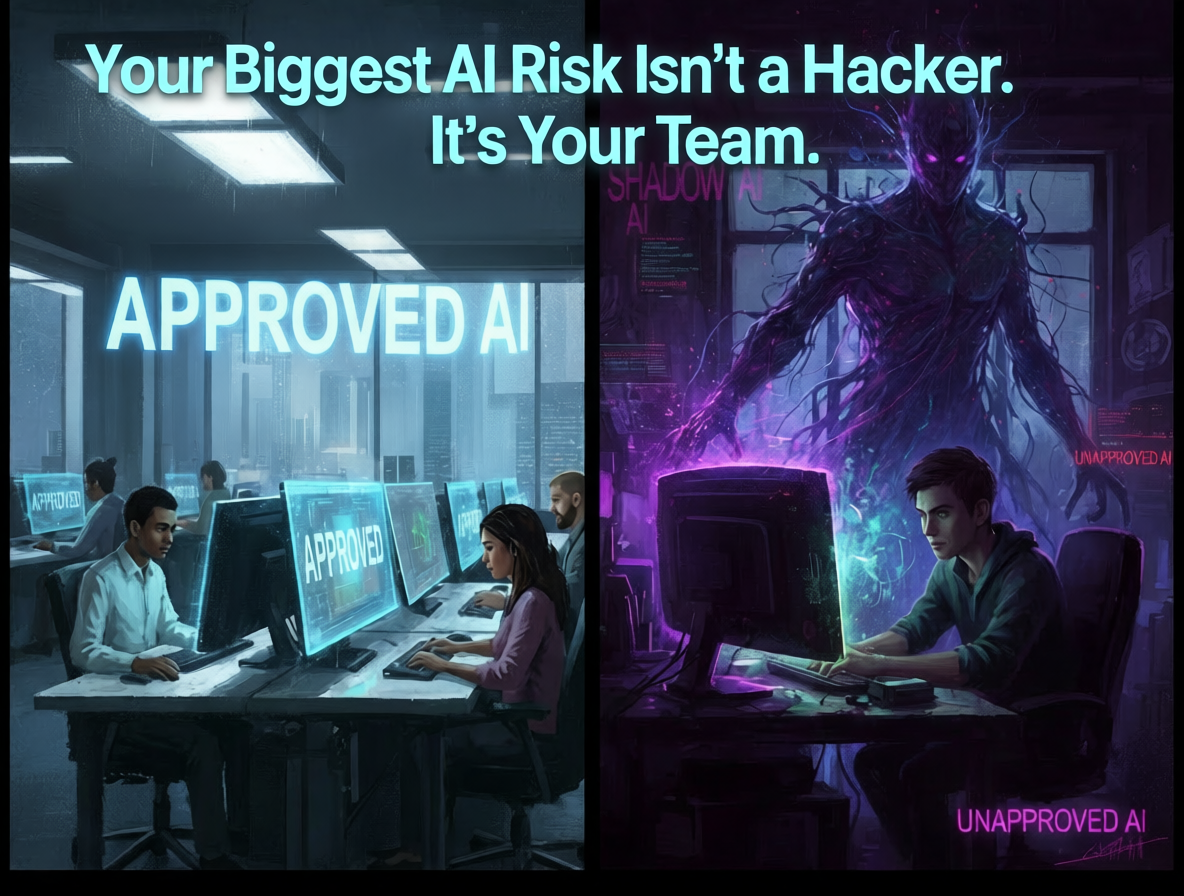
The risk that keeps me up at night for organizations like this isn't a sophisticated cyberattack. It's a well-meaning staff member pasting sensitive information into a free AI tool to draft an email.

That's not hypothetical. Last July, IBM's Cost of Data Breach Report found that one in five organizations experienced a breach tied to shadow AI: tools employees use without IT approval. Those breaches cost an average of $670,000 more than standard incidents. UpGuard confirmed what we see on every engagement: 81% of employees are already using unapproved AI tools at work. Including the security professionals.

For foundations built on donor trust, "we didn't know" is not a sufficient answer. Neither is "we're working on a policy."


What the Process Actually Looks Like

When The Catholic Foundation reached out, they weren't reacting to an incident. They were getting ahead of one. AI features were showing up in the tools their team already used, whether anyone asked for them or not. People wanted to use AI the right way. They just didn't have a playbook. Leadership decided to build the framework before that ambiguity became a problem.

Here's what we mapped out in a few weeks:

Data classification. Not every piece of information carries the same risk. The work starts with drawing clear lines: what never touches an AI tool under any circumstances, what can be used with explicit approval, and what's fair game. The test is simple: if it would be devastating on the front page of a newspaper, it stays out of AI completely.

Tool evaluation. Not all AI tools are created equal. Enterprise tools with contractual data protection agreements are fundamentally different from free consumer tools that may use your data for training. The policy needs a clear approved and prohibited list.

Staff training. Not a lecture about AI theory. Scenario-based: "This situation just came up. What do you do?" The questions that surface are the kind you can't anticipate from a desk: AI features appearing unprompted in existing software, third parties on calls running AI recorders, voice assistants on personal phones.

Board alignment. The governance committee reviewed the policy before the full board. Their board brought the right questions and the experience to evaluate the framework on its merits. The full board approved it, no revisions needed.

The core framework was built in weeks. Review and board approval added a few months to the calendar, but that's governance working the way it should. No dedicated AI team required. No year-long compliance project. Just a decision to be intentional about it.


Why This Matters Beyond One Foundation

Last September, CEP confirmed what we were already seeing: almost two-thirds of foundations and nonprofits are using AI, but data security remains the top concern among foundation leaders, cited by more than 80%. But concern alone doesn't build a framework.

Foundations won't get forced into this conversation by strategy. They'll get forced into it by a board question, a compliance review, or a staff member asking what's allowed.

The Catholic Foundation won't be explaining why they don't have a policy. They'll be pointing to the one they built.


Start With Three Questions

If you lead a foundation or nonprofit, here's where the work begins:

  1. What information does your organization handle that would be catastrophic to expose?
  2. What AI tools are your staff using right now, with or without your knowledge?
  3. Do you have a written policy that answers question two in light of question one?

If the answer to question three is no, that's the gap. And closing it doesn't require a dedicated AI team or a six-figure consulting engagement. It requires a decision to be intentional about how your organization uses AI before the decision gets made for you.

If you want to talk through what a nonprofit AI governance policy looks like for your organization, not a sales pitch, just a straight conversation about your situation, reach out. We'll tell you if you need a formal policy yet. And if you do, we'll show you exactly where to start.


Sources: - 2026 Nonprofit AI Adoption Report, Virtuous/Fundraising.AI, February 2026 - CEP "AI With Purpose" Report, September 2025 - IBM 2025 Cost of Data Breach Report, July 2025 - UpGuard "State of Shadow AI" Research, November 2025

70% of Small Business Leaders Are Betting on AI. Here's What Successful AI Implementation Looks Like.

The Execution Gap

If you run a small business, you've probably had some version of this conversation in the last six months:

"We should be doing something with AI."

Maybe your office manager started using ChatGPT for emails. Maybe a competitor posted about their "AI-powered" workflow on LinkedIn. Maybe you sat through a vendor demo that promised to "transform your operations."

And then nothing happened. Or worse, something happened, but you can't point to what actually changed. Your AI implementation stalled before it started.

You're not alone. And your skepticism isn't a weakness. It's the right instinct.

The AI Implementation Optimism Is Real. The Results Aren't Yet.

The ECI AI Readiness Report came out this week. 550+ owners in manufacturing, field service, and distribution. These are the people in our world.

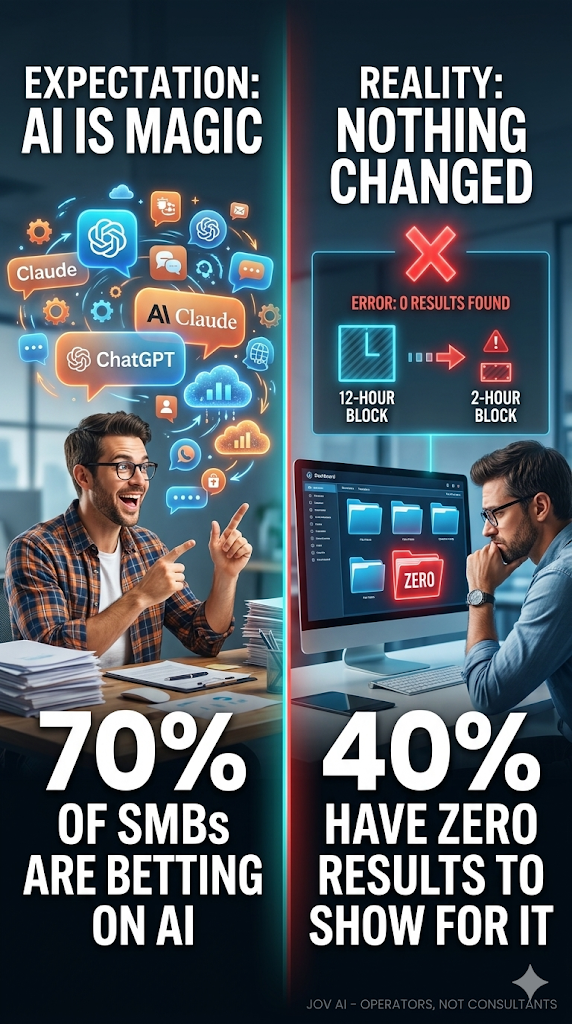
The headline: more than 70% of SMB leaders are positive about AI. That's not Silicon Valley hype. That's owners like you and me saying, "I think this thing can help my business."

But here's where it gets interesting. Despite that optimism, roughly 40% of those same businesses report zero measurable results from their AI efforts so far.

Seventy percent believe. Forty percent can't prove it's working.

That gap is the whole story.

And it's not just SMBs. Here's the kicker: PwC's latest CEO survey shows 56% of CEOs actively investing in AI haven't seen revenue or cost benefits yet. Only one in eight reported gains on both. If large companies with dedicated AI budgets are still struggling to show ROI, budget alone clearly isn't enough.

The will is there. The execution isn't.

What the Winners Are Actually Doing

So what separates the 60% getting results from the 40% who can't point to measurable ones?

It's not budget. It's not team size. It's not which tool they picked.

It's where they started.

The ECI report found that 60% of SMBs using or planning AI are focused on data analysis and reporting. Back-office work. Not chatbots. Not customer-facing AI. The boring stuff: pulling reports, reconciling data, tracking jobs.

That tracks with everything I've seen over the past two years. The wins don't come from flashy demos. They come from finding the one process that eats six hours a week and cutting it to thirty minutes.

Not "let's see what AI can do." Instead: "We spend 12 hours a week manually routing service calls. Can we cut that in half?"

That's the difference between experimenting and operating.

Why Most DIY AI Implementation Projects Stall

Here's a pattern I keep seeing. An owner gets excited about AI, assigns it to someone on their team, usually whoever seems most "tech-savvy," and says, "Figure out how we can use this."

Three months later, that person has tested a dozen tools, built a few clever prompts, and can't point to a single process that actually changed. Not because they're not smart. Because they're learning from scratch while still doing their real job.

Every time, the fix is the same. Stop leading with the technology. Start with the problem. That's what drives everything we do at JOV AI.

We run our business on the same AI systems we build for clients. It's the fastest way to find out what actually works, and the fastest way to kill what doesn't.

Why SMBs Have the Real Advantage

Here's what the big consultancies miss when they publish these reports: small businesses can move faster than anyone.

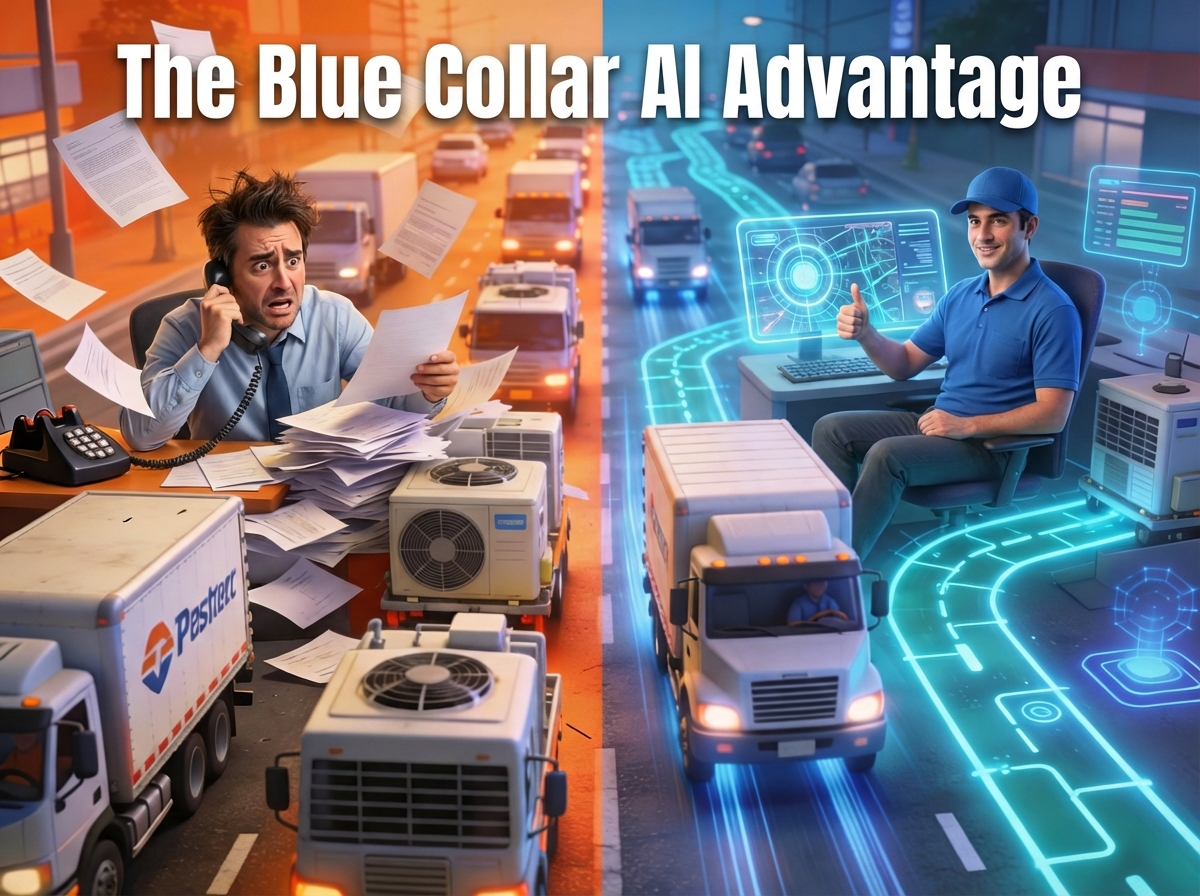
I wrote about this in The Blue-Collar AI Advantage. A 50-person HVAC company doesn't need a change management committee. The owner can decide on Tuesday, implement on Wednesday, and see results by Friday.

That speed is a structural advantage. Shorter decision chains. Closer to the actual work. Less bureaucracy between "this is a good idea" and "let's do it."

But it cuts both ways. When every dollar matters more, you can't afford to experiment blindly. A Fortune 500 company can burn a quarter-million on a failed AI pilot and write it off. You can't.

That's why the bottleneck-first approach matters even more for SMBs. You don't need an AI strategy. You need to fix one expensive problem and prove ROI before you touch anything else.

Stop Running AI Projects. Start Operating Your Business.

The companies getting results from AI aren't "doing AI." They're not running innovation labs or hiring prompt engineers.

They're doing what they've always done: finding inefficiencies and fixing them. AI just happens to be the tool that works right now.

The ECI report named the barriers holding most SMBs back, and none of them are surprising: no in-house expertise, messy data, and no idea where to start. Those aren't technology problems. They're AI implementation problems.

And that's exactly where the gap lives, between "AI can do amazing things" and "here's what it's doing for your P&L this quarter."

The testing phase is over. Seventy percent of your peers are ready to move. The question isn't whether AI works for small business. It's whether you'll be in the 60% getting results or the 40% still unable to point to what changed.

Start Here

What's your most expensive bottleneck this week? The process that eats the most hours, causes the most errors, or keeps you from focusing on growth?

Start there. Not with a chatbot. Not with a strategy deck. With one problem, one measurement, and one fix.

That's how the winners are doing it.

If you want to talk through where AI implementation fits in your operations, not a sales pitch, just a straight conversation about your bottleneck, reach out. We'll tell you if AI isn't the answer. And if it is, we'll show you exactly where to start.

The Blue-Collar AI Advantage Nobody's Talking About

The Blue-Collar AI Advantage

Your best tech is losing two to three hours a day to bad routing. Your estimator is rebuilding the same spreadsheet for the third time this week. Your office manager is chasing invoices instead of chasing growth.

None of that is a technology problem. It's operational drag. And it's capping how fast your business can grow.

Most trades owners assume AI isn't for them yet. That's exactly why the ones adopting it now are pulling ahead so fast. HVAC. Plumbing. Construction. Manufacturing. Field services. Where almost no one has started, even basic AI puts you a generation ahead.

OpenClaw — Why AI Governance Can't Wait?

If you've been on LinkedIn this week, you've seen the posts. Someone's AI agent just booked their flights, summarized their inbox, and scheduled their week—all while they slept.

OpenClaw (formerly Clawdbot, then Moltbot) is being downloaded thousands of times a day. It's the fastest-growing AI agent in history, and it's likely already installed on a laptop in your office.

Here's the problem: this isn't a polished product from Google or Microsoft. It's an experimental tool that, once granted access, can read and write files on your computer. It can execute scripts. It can connect to your email, your calendar, your customer data. And the creator himself says the security is "a work in progress" and it's "not meant for non-technical users."

That hasn't stopped non-technical users from installing it anyway. And most of them have no AI governance in place.

OpenClaw AI Governance

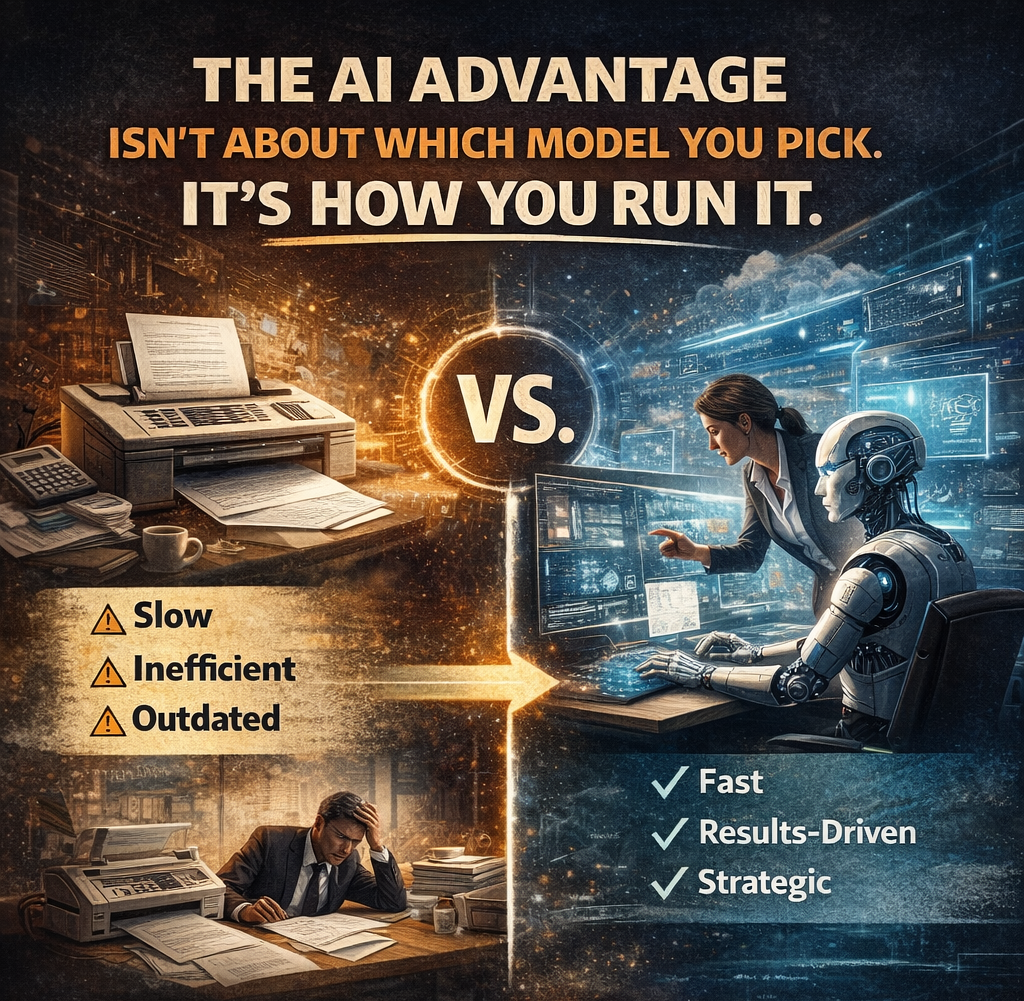
The AI Advantage Isn't About Which Model You Pick. It's How You Run It.

Every few months, a new AI model drops and the internet loses its mind. GPT-5-whatever. Gemini-some-number. The next thing.

It's like the iPhone when they were new—each number was a big deal. I used to get excited too. But can you honestly tell me the kid fresh out of college is getting more ROI out of a new iPhone than the business operator on one that's three years old?

Now, look at the guy who doesn't have a cell phone and is still faxing documents—how's he doing?

That's what I mean. Debating which AI model to use is like worrying about which carrier to get cell service through. Meanwhile, most business owners haven't figured out what to do with the last model.

Here's what's easy to miss in the noise: the models got good. Really good. Three years ago, AI couldn't write a decent email. Now it can draft proposals, analyze contracts, and handle first-line customer support. Small and medium-sized businesses have access to the same capabilities enterprise companies are spending millions to deploy.

So why are some businesses pulling ahead while others spin their wheels?

It's not which AI they picked. It's how they run it.

The AI Advantage

What Are You Waiting For?

82% of enterprise decision-makers now use AI weekly. 46% use it daily. These aren't employees experimenting on the side—these are the people running things. VPs, C-suite, the ones setting strategy and making decisions. (Wharton, 2025)

Meanwhile, only about 9% of small businesses have adopted AI. (SBA, 2025) That's SBA's cut of Census data on firms reporting active AI use, not just experimentation.

That's the gap. The models are the same. You have access to the same AI enterprise leaders are using daily.

4 Years in AI: Trial by Fire

4 Years in AI

In 2022, I walked away from a 15-year career in bond trading to build AI models. I thought I knew exactly how this would play out.

I was right about the opportunity. I was wrong about the timeline.

That gap between promise and payoff is the real story, and it's the reason most small businesses still haven't figured out how to make AI work for them.

We Evaluated 250+ Tools So You Don't Have To: The Ultimate Guide to Best-of-Class Business Technology

How systematically evaluating every major business tool revealed the hidden gems and costly mistakes most companies never discover

As the founder of AutomateIX working with rapidly scaling businesses, I've witnessed the same painful pattern dozens of times: companies burning through thousands of dollars monthly on tool subscriptions while their teams remain frustrated, inefficient, and drowning in disconnected workflows.

The problem isn't a lack of tools—it's the opposite. With over 30,000 SaaS tools available today, the paradox of choice has created a new form of organizational paralysis. Teams spend more time evaluating, switching, and managing tools than actually using them to drive results.

That's why I embarked on what might be the most comprehensive tool evaluation project ever attempted by a single organization. Over the past 18 months, I've systematically evaluated 250+ tools across 12 major technology categories, spending over $800 monthly on subscriptions, conducting in-depth testing, and building real-world implementations to separate the marketing hype from actual business value.

The result? A definitive guide to what actually works—and more importantly, what doesn't.

Embracing AI: Your Job Is Evolving, Not Disappearing

In this presentation, we'll explore how AI is changing the workplace, address common fears, and discover how humans and AI can collaborate effectively to enhance your career rather than threaten it.

Understanding Your Concerns

73%

Worried Workers

Recent surveys show that 73% of employees worry about AI replacing their jobs

24/7

Media Coverage

Headlines constantly feature "AI will replace X jobs" narratives

2X

Rapid Advancement

AI capabilities are progressing twice as fast as many predicted

Your anxiety is completely understandable. Past waves of automation did eliminate certain roles, and the pace of AI development can seem overwhelming. But history tells a different story about technology's overall impact on jobs.

Learning From History: Technology as a Tool

Historical Examples That Prove the Pattern:

Successful professionals don't get replaced by technology—they learn to wield it. Expert pilots use autopilot to handle routine flight while they focus on weather decisions and emergency responses. Experienced doctors use diagnostic AI to enhance their pattern recognition while applying decades of clinical judgment. Experienced engineers use CAD software to rapidly prototype while contributing years of systems thinking and constraint optimization. The pattern is clear: technology amplifies expertise, creating hybrid intelligence that exceeds either humans or AI working alone.

Historical technology adoption pattern

Addressing the 'Different This Time' Argument:

Yes, this IS different—and that's exactly why action is urgent. AI isn't a rising tide that lifts all boats equally. Those who learn to use it gain exponential advantages, while those who don't fall dramatically behind. We're already seeing 10-20x productivity gains for AI-fluent professionals—work that used to take weeks now completed in hours. The question isn't whether AI will disrupt your industry—it's whether you'll be among the disruptors or the disrupted.

From Replacement to Collaboration

The most successful AI implementations follow a collaboration model rather than a replacement model. This addresses core fears about job security by positioning AI as an enhancement to your work.

Enhancement vs. Replacement

Instead of "your job is gone," the reality is "your job is evolving" to incorporate AI assistance

Increased Value

Workers who learn to leverage AI effectively become more valuable to their organizations

Hybrid Roles

New positions are emerging that specifically require both human expertise and AI skills

Real-World Collaboration Examples

Healthcare professionals using AI

Healthcare Professionals

AI assists with diagnosis and data analysis, while doctors focus on patient care, complex cases, and treatment decisions that require empathy and judgment

Educators using AI

Educators

AI handles grading and administrative tasks, allowing teachers to focus on mentoring, fostering creativity, and providing personalized guidance to students

Legal professionals using AI

Legal Professionals

AI reviews documents and conducts research, freeing lawyers to focus on negotiation, counseling clients, and applying complex legal reasoning

The Economic Case for Human-AI Collaboration

Benefits for Companies

  • Higher employee satisfaction and retention rates
  • Smoother technology transition with less resistance
  • Better outcomes through human oversight and judgment
  • Preservation of valuable institutional knowledge

Benefits for Workers

  • Gradual skill development versus sudden obsolescence
  • Increased productivity makes you more valuable
  • New career advancement paths in AI collaboration
  • Higher job satisfaction with less tedious work

Research Finding:

Companies that implement collaborative AI models report 35% higher employee retention and 28% greater productivity gains than those pursuing automation-only approaches.

Your Transition Strategy

1

Awareness

Understand how AI is affecting your specific role and industry

2

Exploration

Experiment with AI tools relevant to your work to understand capabilities

3

Skill Development

Focus on uniquely human skills that complement AI (creativity, empathy, complex reasoning)

4

Integration

Develop workflows that combine your expertise with AI assistance

5

Evolution

Position yourself for new hybrid roles that require both human and AI capabilities

Developing Your AI Collaboration Skills

AI Literacy

Understanding AI capabilities and limitations without becoming a programmer

Human Expertise

Deepening your unique skills that AI cannot replicate

Context Engineering

Learning how to effectively communicate with AI tools to get better results

Critical Evaluation

Developing the ability to verify and improve AI outputs

These skills form a continuous cycle of improvement as you work alongside AI tools. The goal is to leverage AI for routine tasks while applying your distinctly human capabilities to add greater value.

Your Uniquely Human Advantages

Human advantages in AI workplace

While AI continues to advance, certain human capabilities remain distinctly valuable and difficult to replicate. These are your competitive advantages in an AI-enhanced workplace:

Subject Matter Expertise

Deep contextual knowledge gained through years of hands-on experience and industry relationships

Emotional Intelligence

Understanding nuanced human emotions and responding with genuine empathy

Ethical Judgment

Making complex decisions that involve moral considerations and human values

Creative Innovation

Generating truly novel ideas that transcend existing patterns and data

Moving Forward Together

1

Acknowledge Your Concerns

Your fears about AI are valid, but history shows technology tends to transform rather than eliminate jobs

2

Embrace Collaboration

View AI as a powerful tool that can handle routine tasks while you focus on higher-value work

3

Develop New Skills

Invest in learning both AI literacy and uniquely human capabilities that complement technology

4

Shape Your Future

Position yourself for emerging hybrid roles that combine human expertise with AI assistance

The future of work isn't about humans versus AI—it's about humans with AI creating more value than either could alone.