70% of Small Business Leaders Are Betting on AI. Here's What Successful AI Implementation Looks Like.#
If you run a small business, you've probably had some version of this conversation in the last six months:
"We should be doing something with AI."
Maybe your office manager started using ChatGPT for emails. Maybe a competitor posted about their "AI-powered" workflow on LinkedIn. Maybe you sat through a vendor demo that promised to "transform your operations."
And then nothing happened. Or worse, something happened, but you can't point to what actually changed. Your AI implementation stalled before it started.
You're not alone. And your skepticism isn't a weakness. It's the right instinct.
The AI Implementation Optimism Is Real. The Results Aren't Yet.#
The ECI AI Readiness Report came out this week. 550+ owners in manufacturing, field service, and distribution. These are the people in our world.
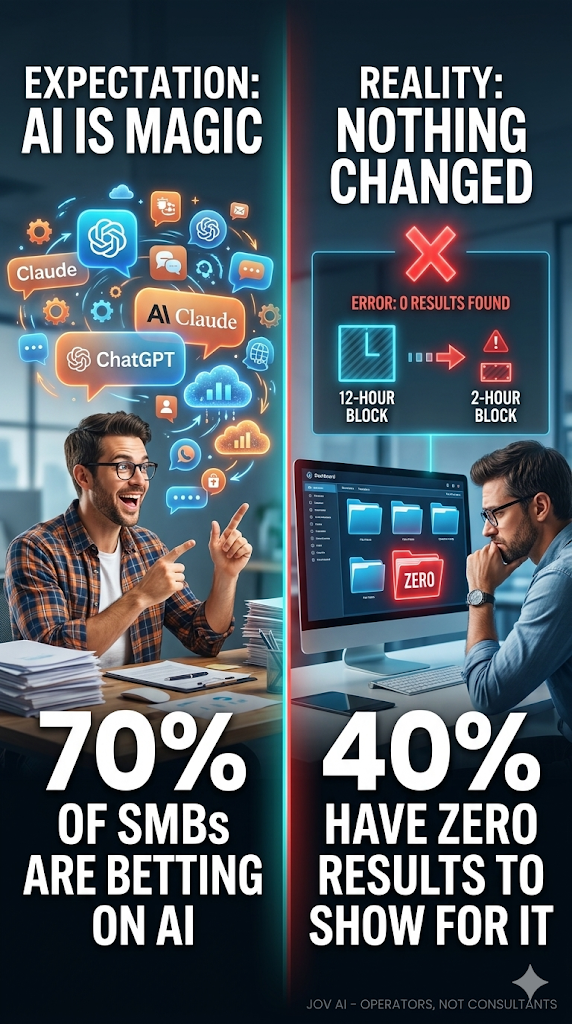
The headline: more than 70% of SMB leaders are positive about AI. That's not Silicon Valley hype. That's owners like you and me saying, "I think this thing can help my business."
But here's where it gets interesting. Despite that optimism, roughly 40% of those same businesses report zero measurable results from their AI efforts so far.
Seventy percent believe. Forty percent can't prove it's working.
That gap is the whole story.
And it's not just SMBs. Here's the kicker: PwC's latest CEO survey shows 56% of CEOs actively investing in AI haven't seen revenue or cost benefits yet. Only one in eight reported gains on both. If large companies with dedicated AI budgets are still struggling to show ROI, budget alone clearly isn't enough.
The will is there. The execution isn't.
What the Winners Are Actually Doing#
So what separates the 60% getting results from the 40% who can't point to measurable ones?
It's not budget. It's not team size. It's not which tool they picked.
It's where they started.
The ECI report found that 60% of SMBs using or planning AI are focused on data analysis and reporting. Back-office work. Not chatbots. Not customer-facing AI. The boring stuff: pulling reports, reconciling data, tracking jobs.
That tracks with everything I've seen over the past two years. The wins don't come from flashy demos. They come from finding the one process that eats six hours a week and cutting it to thirty minutes.
Not "let's see what AI can do." Instead: "We spend 12 hours a week manually routing service calls. Can we cut that in half?"
That's the difference between experimenting and operating.
Why Most DIY AI Implementation Projects Stall#
Here's a pattern I keep seeing. An owner gets excited about AI, assigns it to someone on their team, usually whoever seems most "tech-savvy," and says, "Figure out how we can use this."
Three months later, that person has tested a dozen tools, built a few clever prompts, and can't point to a single process that actually changed. Not because they're not smart. Because they're learning from scratch while still doing their real job.
Every time, the fix is the same. Stop leading with the technology. Start with the problem. That's what drives everything we do at JOV AI.
We run our business on the same AI systems we build for clients. It's the fastest way to find out what actually works, and the fastest way to kill what doesn't.
Why SMBs Have the Real Advantage#
Here's what the big consultancies miss when they publish these reports: small businesses can move faster than anyone.
I wrote about this in The Blue-Collar AI Advantage. A 50-person HVAC company doesn't need a change management committee. The owner can decide on Tuesday, implement on Wednesday, and see results by Friday.
That speed is a structural advantage. Shorter decision chains. Closer to the actual work. Less bureaucracy between "this is a good idea" and "let's do it."
But it cuts both ways. When every dollar matters more, you can't afford to experiment blindly. A Fortune 500 company can burn a quarter-million on a failed AI pilot and write it off. You can't.
That's why the bottleneck-first approach matters even more for SMBs. You don't need an AI strategy. You need to fix one expensive problem and prove ROI before you touch anything else.
Stop Running AI Projects. Start Operating Your Business.#
The companies getting results from AI aren't "doing AI." They're not running innovation labs or hiring prompt engineers.
They're doing what they've always done: finding inefficiencies and fixing them. AI just happens to be the tool that works right now.
The ECI report named the barriers holding most SMBs back, and none of them are surprising: no in-house expertise, messy data, and no idea where to start. Those aren't technology problems. They're AI implementation problems.
And that's exactly where the gap lives, between "AI can do amazing things" and "here's what it's doing for your P&L this quarter."
The testing phase is over. Seventy percent of your peers are ready to move. The question isn't whether AI works for small business. It's whether you'll be in the 60% getting results or the 40% still unable to point to what changed.
Start Here#
What's your most expensive bottleneck this week? The process that eats the most hours, causes the most errors, or keeps you from focusing on growth?
Start there. Not with a chatbot. Not with a strategy deck. With one problem, one measurement, and one fix.
That's how the winners are doing it.
If you want to talk through where AI implementation fits in your operations, not a sales pitch, just a straight conversation about your bottleneck, reach out. We'll tell you if AI isn't the answer. And if it is, we'll show you exactly where to start.