A Real AI Automation Sprint Ends With a Working Workflow
Most AI projects do not fail because the model was weak.
They fail because nobody forced the business process into something real enough to run.
That is the part people skip.
Grant Thornton's 2026 AI Impact Survey of 950 senior business leaders found that organizations with fully integrated AI were far more likely to report revenue growth than those still stuck in pilots.
A company gets excited about AI. Somebody runs a demo. The room lights up. A pilot gets approved. Then the whole thing stalls the second it has to survive real operations.
Because a demo is not a workflow.
And an outcome is the only thing that matters.
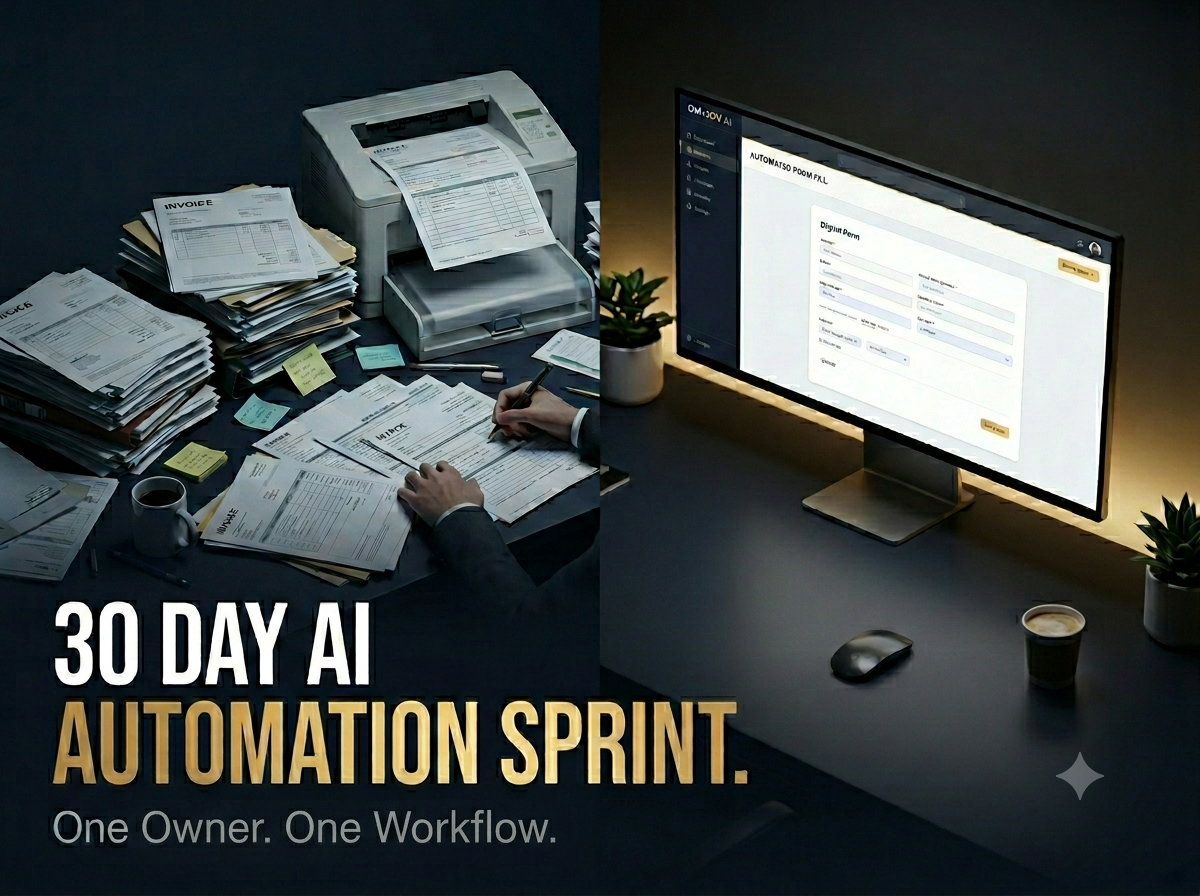
If you are running a real AI Automation Sprint, the goal is not to leave with a slide deck, a prototype, or a list of future ideas. The goal is to leave with one working system tied to one operational bottleneck that matters enough to fix.
That is the standard.
Start With the Drag, Not the Tool
I would not start a sprint by asking what model you want to use.
I would start by asking what is slowing the business down every single week.
What gets stuck in inboxes?
What gets rekeyed by hand?
What requires somebody to chase three systems just to answer one customer question?
What depends on one employee who "just knows how it works"?
That is where the sprint starts.
Not with AI as a concept.
With drag.
Intuit's 2026 AI Impact Report reinforces this.
If you cannot name the bottleneck clearly, the sprint will drift. It turns into experimentation without consequence. People stay busy, but nothing meaningful ships.
A real sprint needs a tighter frame:
- one workflow
- one owner
- one measurable outcome
This friction is real. That is how you stop an AI project from turning into theater.
Data Prep Shows You the Truth
This is the part people underestimate.
They assume the workflow is clean because the team can describe it in a meeting.
It usually is not.
The files are messy. The fields are inconsistent. The CRM says one thing, the spreadsheet says another, and half the process lives in side conversations nobody documented. Then you find the exceptions. Then you find the approvals nobody mentioned. Then you find the step where somebody quietly fixes bad data before it breaks downstream.
Good.
That is exactly what you want to find early.
I would rather find the mess in week one than after launch.
Taking the time here is what separates the sprints that hold up from the ones that quietly fall apart after launch. The best sprint teams sit in it long enough to understand what has to be cleaned up, what can be automated, and where human judgment still belongs.
That is not delay.
That is implementation.
Prototype Fast, But Do Not Trust It Blindly
Once the workflow is scoped and the inputs are clear enough, then you build.
Fast matters.
Blind does not.
The first prototype is not there to impress people. It is there to expose weak spots while the stakes are still low.
Where does the output break?
Where does the logic fail?
What does the system handle well?
What still needs review?
What should never run without approval?
Those questions matter a lot more than whether the prototype looks polished.
If the output cannot be checked, it is not ready.
If nobody can explain when a person steps in, it is not ready.
Integration Is the Real Test
A workflow is not real because it worked once in a sandbox.
It is real when it fits the business the way the business actually runs.
That means it has to live where the work already lives. In the inbox. In the CRM. In the file flow. In the approval chain. In the places where people actually make decisions and hand work off to the next person.
This is where a lot of pilots quietly die.
They looked good in isolation. Then they hit the real operating environment and exposed every unresolved problem underneath them.
Weak ownership.
Messy inputs.
No exception handling.
No agreement on what happens when the output is wrong.
No defined handoff back to a human.
That is the moment the business stops trusting the system.
And once trust drops, usage drops right behind it.
Governance Is Part of the Build
A lot of teams treat governance like paperwork.
That is a mistake.
Governance is what keeps a useful workflow from turning into a liability. It isn't just paperwork — it's how you protect the value of your process. As explored in our piece, Why Your Domain Expertise Is More Valuable Than Your AI Prompt, the technology only works when it's framed by the specific business logic you already own.
Before handoff, I want clear answers to basic questions:
Who owns this workflow?
What gets logged?
What triggers review?
What can the system do on its own?
What is it explicitly not allowed to do?
Those are not legal questions.
Those are operating questions.
Without them, small mistakes compound. People stop trusting the system. Work starts routing around it. The workflow becomes one more thing the business has to manage instead of one more thing helping the business move faster.
Governance does not slow the sprint down.
It is part of what makes the sprint worth doing.
What the Sprint Should Actually Deliver
By the end of a real AI Automation Sprint, the business should have something concrete:
- one working workflow
- one owner
- one measurable result
- clear guardrails
- a clear definition of where human judgment stays in the loop
Not a presentation.
Not a proof of concept that only works when the builder is in the room.
Not a pile of ideas for phase two.
A working system doing useful work now.
That is the bar.
A sprint gets you the first workflow.
Keeping it performing, governing it well, and expanding it across the business is the next job.
But if the first workflow is not real, none of that matters.
Most companies do not need another AI demo.
They need one outcome worth chasing, and the workflow that reliably delivers it.
Sources: Grant Thornton, "2026 AI Impact Survey" (950 business leaders, fielded February–March 2026), https://www.grantthornton.com/services/advisory-services/artificial-intelligence/2026-ai-impact-survey; Intuit QuickBooks, "2026 AI Impact Report" (May 2026), https://www.intuit.com/blog/global-stories/ai-impact-report/; JOV AI, "Why Your Domain Expertise Is More Valuable Than Your AI Prompt" (April 2026); JOV AI, "The Cost of Software Is Now Zero" (March 29, 2026)