Your Biggest AI Risk Isn't a Hacker. It's Your Team.#
And they're not doing anything wrong — that's the scary part.
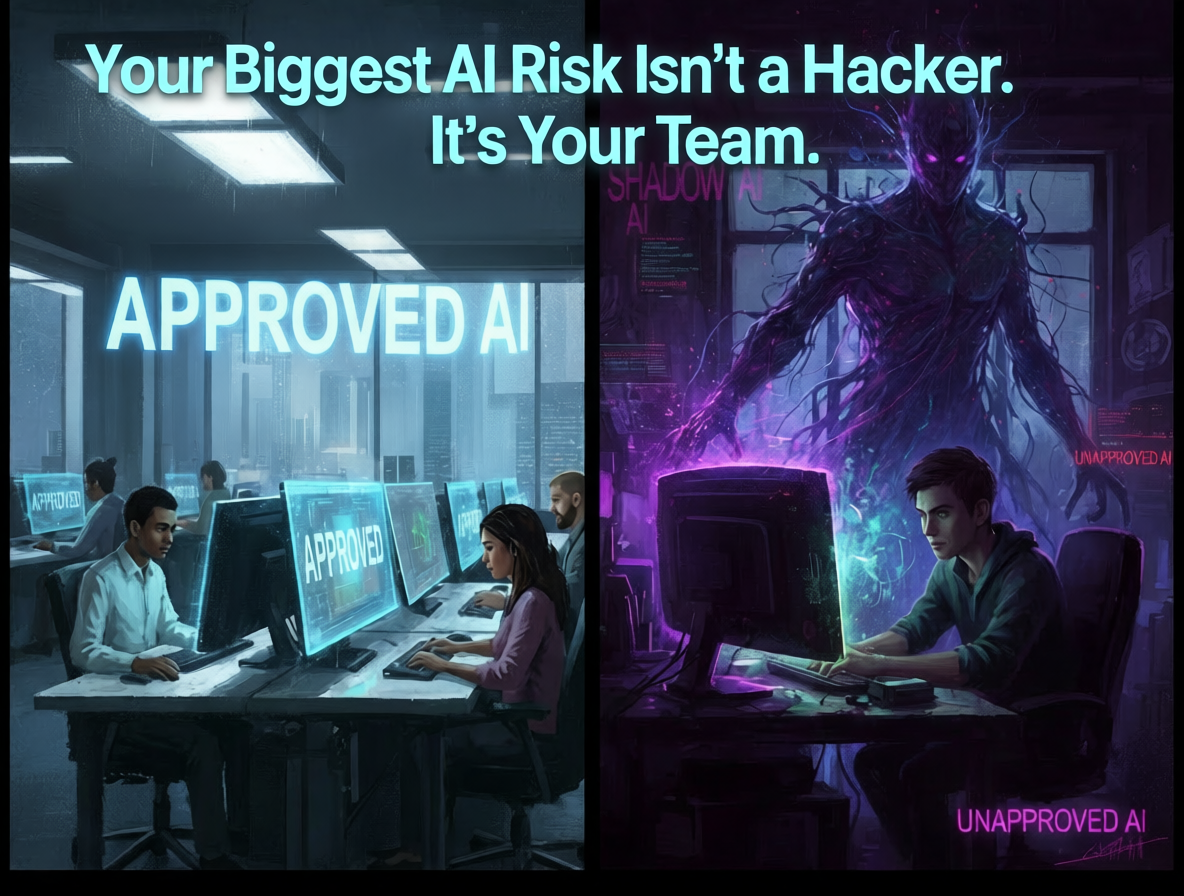
Here's a number that should keep you up tonight: one in five organizations experienced a data breach last year because of shadow AI. Not because a hacker found a backdoor. Not because someone clicked a phishing link. Because their own employees used AI tools that nobody in leadership knew about.
And those breaches? They cost $670,000 more than the average incident. We're talking $4.63 million versus $3.96 million per breach — just because someone on your team uploaded client data to a chatbot they found on their lunch break. (IBM 2025 Cost of Data Breach Report)
I want to be clear about something before we go further: your employees aren't villains here. They're doing exactly what smart, motivated people do — finding tools that help them work faster. The problem isn't their initiative. It's the vacuum they're operating in.
The Problem You Can't See#
Shadow AI is simple to understand: it's any AI tool your team uses that your company hasn't approved, vetted, or even heard of. And it is everywhere.
More than 80% of workers now use AI tools their employers haven't sanctioned. (Microsoft/UpGuard, 2025) Nearly half — 47% — access AI through personal accounts your IT team can't monitor or control. (Netskope Cloud & Threat Report, 2026)
Think about what that means practically. Your marketing lead is drafting emails through a free AI tool she found on Twitter. Your accountant is summarizing financial reports through a chatbot he logs into with his personal Gmail. Your operations manager is feeding customer lists into an AI workflow builder that stores data on servers you've never heard of.
None of them think they're doing anything risky. They're just trying to get more done in less time.
The scale of it is staggering. The average organization now logs 223 data policy violations involving generative AI every single month. For companies in the top quartile of exposure? That number is 2,100 per month. (Netskope, 2026)
What's Actually at Stake#
Let's get specific about what you're risking, because "data breach" can feel abstract until you see the breakdown.
Of the organizations that experienced shadow AI breaches, 65% had customer personal information compromised. Names, emails, Social Security numbers, financial records — the kind of data that triggers regulatory notifications, lawsuits, and destroyed trust. (IBM, 2025)
The number-one type of data exposed through AI tools? Source code — 42% of all GenAI data policy violations involve proprietary code being fed into AI assistants. Regulated data comes second at 32%, intellectual property at 16%. (Netskope, 2026)
Here's what makes shadow AI breaches particularly dangerous: 97% of organizations that experienced AI-related breaches lacked proper access controls. (IBM Newsroom, July 2025) They didn't just miss the threat — they had no system in place to catch it.
And these incidents are harder to find. Shadow AI breaches averaged 247 days before detection — nearly a week longer than conventional breaches, and that's with most organizations unaware they had an AI exposure problem in the first place. (IBM, 2025) By the time you know something happened, the damage has been compounding for months.
Why Banning Doesn't Work#
I know what some of you are thinking: "Fine. We'll just ban all unauthorized AI tools."
Good luck with that.
60% of employees say they'd accept security risks to meet deadlines — and nearly half are already using AI tools their company hasn't sanctioned. (BlackFog, January 2026) You're not dealing with people who are defiant. You're dealing with people under real pressure who've found tools that genuinely make them better at their jobs. When the choice is "miss the deadline" or "use the chatbot," the chatbot wins every time.
The data backs this up. Nine out of ten organizations now actively block at least one GenAI application. On average, companies block ten different AI tools. (Netskope, 2026) And shadow AI usage is still growing. The number of GenAI users in the workplace grew 200% year-over-year, and the volume of prompts sent to AI tools increased 500%.
Banning AI tools is like banning the internet in 1998. The train has left the station. The question isn't whether your team uses AI — they already do. The question is whether they're using it in a way that doesn't create exposure you can't undo.
The Fix: AI Governance That Actually Works#
Here's the practical framework. No jargon, no six-month consulting engagement required.
And if you're running a 25- to 200-person company without a full-time CISO or a dedicated security team — this is actually designed for you. You don't need enterprise-grade tooling to get this right. You need clarity, a few honest conversations with your team, and a written policy that fits on two pages. The smaller your organization, the faster you can move on this.
Step 1: Discover#
You can't manage what you can't see. Before you write a single policy, you need to know what's actually happening in your organization.
Start with a simple, confidential survey: What AI tools do you use? How often? What kind of data do you put into them? Make it clear this isn't a witch hunt — it's a fact-finding mission. You'll be surprised by the answers. Most leaders are.
Pair the survey with a technical audit. Check browser extensions, SaaS subscriptions, and network traffic for AI tool usage. Remember — only 17% of companies have technical controls in place to even detect AI data uploads. (Kiteworks, 2026) If you haven't looked, you don't know.
Step 2: Contain#
Once you know what's out there, create boundaries that work with your team, not against them.
This means approving specific AI tools with proper security configurations. Set up enterprise accounts where data stays within your control. Define what types of data are never okay to put into an AI tool — customer PII, financial records, source code, legal documents — and make those lines bright and clear.
The goal isn't zero AI usage. The goal is zero unsupervised AI usage. Give people approved tools that are genuinely useful, and they'll have far less reason to go rogue.
Step 3: Govern#
Policy without enforcement is just a suggestion. And right now, 63% of organizations either don't have an AI governance policy or are still trying to figure one out. Only 15% have even updated their Acceptable Use Policies to mention AI. (IBM, 2025; Kiteworks, 2026)
Your governance framework doesn't need to be a hundred-page document. It needs to answer four questions:
- What AI tools are approved, and how do employees request new ones?
- What data can never go into AI, regardless of the tool?
- Who is accountable when things go wrong?
- How often do we review and update this policy?
Write it down. Train your team on it. Review it quarterly. That puts you ahead of two-thirds of your peers.
And here's the business case for urgency: Gartner predicts that one in four compliance audits in 2026 will include AI governance inquiries. (Gartner, January 2026) If you don't have a policy when the auditor shows up, that's a problem you could have prevented.
This Is Worth a Conversation#
Shadow AI isn't going away. Your team is using AI tools right now — the only variable is whether you have visibility and control, or whether you're hoping for the best.
We help organizations go from "we have no idea what's happening" to a working AI governance framework — policy, data classification, tool approval process — in 90 days. The first step is a 20-minute conversation to see where you stand.
If you're a leader who takes data security seriously, this is worth that conversation.
Sources cited in this article are linked inline. Key reports: IBM 2025 Cost of Data Breach Report, Netskope 2026 Cloud & Threat Report, Kiteworks AI Data Security Crisis 2026.