Why Your Domain Expertise Is More Valuable Than Your AI Prompt#
Most business owners are quietly paying for software that almost fits their business.
A platform that locks them in. A vendor that ships features they didn't ask for. A line item that climbs every renewal whether the team uses it or not.
Last month, an owner in a room I was in mentioned, almost as an aside, that he'd built his own property management operating system with AI. In seven days. The kind of thing his industry rents from vendors for around $200,000 a year.
The room went quiet.
Here's the shift: it's not about software getting cheaper. It's about your unfair advantage finally becoming buildable.
You could feel everyone recalibrate.
Ben already wrote the software-side argument from this same session: the cost of software is moving toward zero. He's right.
But the lesson isn't "I should build all my own software now."
The real lesson is simpler.
AI makes domain expertise executable.
The Build Was Impressive. The Builder Mattered More.#
Everyone asks one question: "What tool did he use?"
The answer is the trap.
You'll copy the tool. You won't copy the understanding.
The build worked because he knew the business. He knew which fields mattered and which ones only existed because a vendor needed them. He knew which reports helped people make decisions. He knew the weird exceptions that break clean workflows. He knew the handoffs that quietly fail near renewal time.
That's the part a generic software product never has on day one.
It's also the part a junior "AI hire" doesn't have. A smart kid can learn the tools. They can't walk in and know why a dashboard is lying, which tasks create risk, or why the same customer record shows up three different ways.
The AI didn't replace business knowledge.
It finally gave business knowledge a build surface.
The Prompt Is the Visible Part. The Judgment Is the Asset.#
Most companies get this backwards. They look at a story like the seven-day build and decide they need to find the person who can prompt the best.
That's the wrong hire.
If you ask AI to build a workflow and you can't explain how the workflow should actually work, you get noise. Maybe polished noise. Maybe useful-looking noise. But still noise.
The model isn't the bottleneck. The clarity is.
The owner in that room didn't succeed because he had a magic prompt. He succeeded because he could look at an AI-built version of his business and say:
This field is wrong.
This report is missing the decision.
This handoff will fail at renewal.
This is how my team actually works.
This step needs to happen before the manager ever sees it.
That's not technical knowledge. That's operator knowledge. And right now, operator knowledge is wildly underpriced.
Why This Shift Happens Now#
Three years ago, this story would have started with a developer. Scoping took weeks. The first useful version cost real money before anyone knew whether the workflow was right.
Today, the operator can build the rough first version himself. Then someone with software judgment hardens what works: permissions, data quality, security, reliability, and edge cases.
That changes the economics. The first question is no longer, "Can we afford custom software?" It is, "Can we prove this workflow is worth owning?"
That is where JOV fits. We are not trying to replace operator judgment with tools. We are trying to turn operator judgment into working systems.
Your Unfair Advantage Is the Stuff Vendors Never Learn#
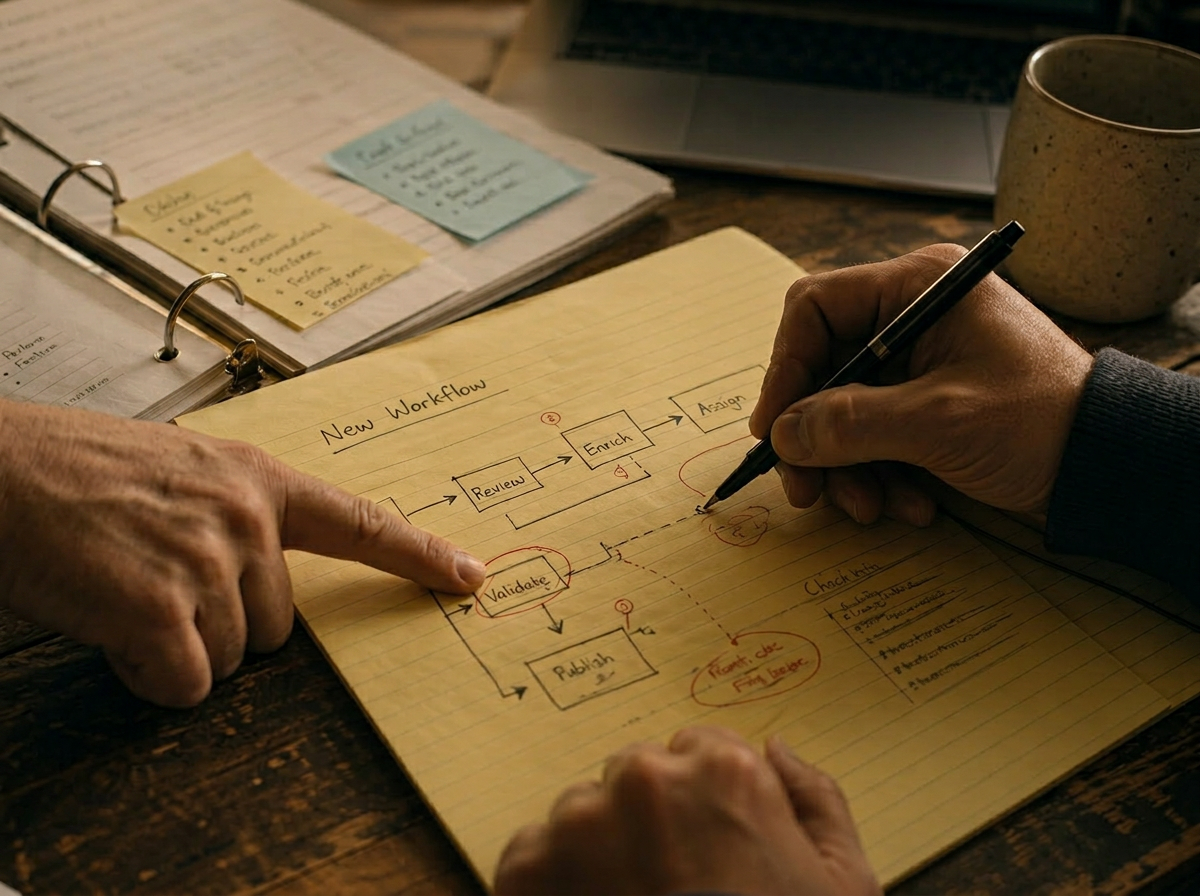
Every business has an operating layer vendors never learn: the Friday spreadsheet, the client report stitched together from three systems, the intake exception, the renewal workflow carried by a veteran employee.
That stuff is invisible. It's also where AI gets real.
Not "write me a strategy." Build the thing that removes drag from the business you already understand.
That's why the seven-day build matters. Not because every owner should spend the weekend replacing their software stack. Most shouldn't. Security, permissions, data quality, and production reliability still matter.
It matters because it proves the bottleneck moved. The bottleneck used to be whether you could afford software built around your business. Now it is whether you can describe the work clearly enough for AI to help build it.
What This Looks Like at SMB Scale#
The seven-day build is the dramatic version. Here's the everyday one.
A multi-location wellness operator I work with runs the business on a vertical-specific accounting and booking platform that costs around $150,000 a year. The kind that keeps everything in a closed ecosystem because that's how they upcharge you. Every adjacent feature is a paid line item. The person handling operations isn't a developer, but he knows the business. Over the last several months, he has been using AI to build small apps that work around the closed platform. Each one replaces one paid upsell. He's stacking these.
Ben is helping turn the working ones into production-grade tools. That's the maturity arc: an operator builds the first version because he knows the business. Someone with software judgment hardens what works for security, reliability, and the edge cases. Neither half does it alone.
That's the model. It scales down to one retired line item at a time, and up to a $200K system in seven days.
Two Bad Reactions, One That Actually Works#
We see two predictable reactions to this shift.
The first is DIY bravado. "Great, software is free. We'll build everything ourselves."
Result? A prototype becomes one person's private system. No permissions model. No audit trail. No one else trusts the data, so the old vendor stays live in parallel.
The second is vendor reflex. "Great, let's hire an AI person and have them figure it out."
Result? Someone learns the tools but never the business. They automate the obvious stuff and miss the expensive stuff: the exception, the handoff, the renewal risk, the report that actually drives a decision.
The version that works is a partnership.
One operator inside who can say what good looks like. One implementation partner outside who can turn that into AI workflows, software, automations, and guardrails.
Start with the workflow that already has a number attached to it: the tool you keep renewing reluctantly, the report that takes six hours, the handoff that creates rework, or the process your best employee carries in their head.
If you can't put a dollar, hour, risk, or revenue number on it, it can wait.
The Next Seven Days#
Don't start by asking, "What app should we build?"
Start with three questions:
- What part of the business do we understand better than any vendor ever will?
- What recurring workflow is expensive because it's trapped in people, spreadsheets, or rented software?
- Who inside the business can judge whether the AI-built version is actually right?
That third question is the one most people skip.
Without that person, AI produces demos. With that person, AI produces operating leverage.
That's the shift. For SMB owners, it's the opportunity.
Start here: which of these is costing you the most?
- [ ] A vendor subscription for features your team doesn't use
- [ ] A manual report or process your best employee carries in their head
- [ ] A workflow trapped between three systems with no clean handoff
- [ ] A renewal price that climbs every year
Pick one. Then Let's Talk. We'll use it to scope the first useful build: the smallest workflow that can free capacity, retire spend, reduce risk, or unblock revenue.
Sources: