Only 11% of Companies Are Scaling AI. The Rest Keep Starting Over.#
You automated a workflow. It worked. Maybe you saved six hours a week on reporting, or cut your meeting prep in half. Your team noticed. You felt the win.
Then you tried to do it again in another department and hit a wall.
That wall is where most businesses get stuck. Not at the start. After the start.
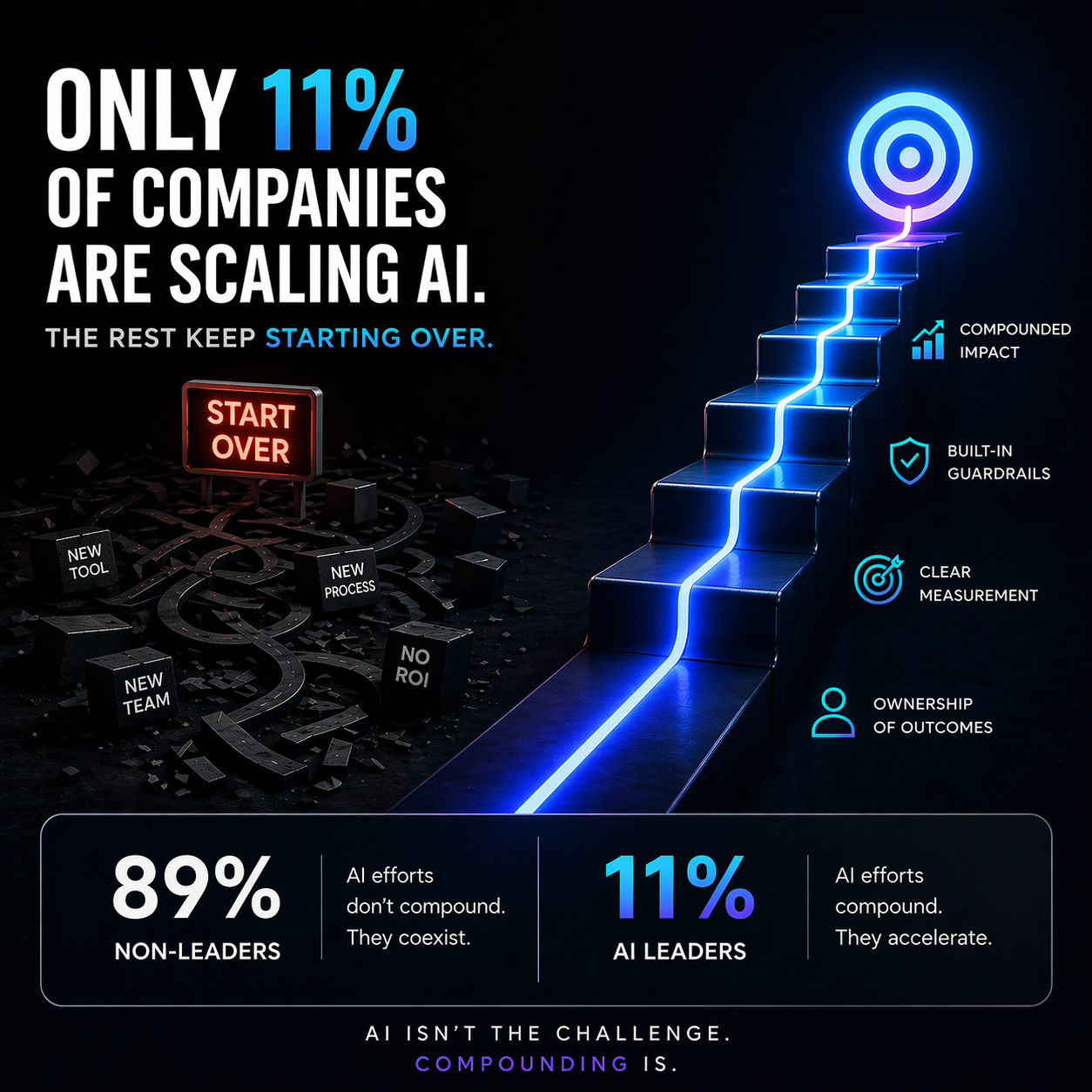
Here's the number I can't get past: only 11% of companies qualify as AI leaders in KPMG's Q1 2026 Global AI Pulse.
Not 11% using AI. Almost everyone is using AI.
Eleven percent getting coordinated results across the business.
The other 89% aren't failing. They're just not compounding.
And yes, KPMG's sample is larger companies. But I see the same pattern even faster in SMBs, where smaller teams have less room for vague ownership and broken handoffs.
The Word Nobody Wants to Hear#
Here's the word most business owners don't want to hear: governance.
I know. You heard "governance" and thought: lawyers, compliance, red tape.
That's not what I mean.
McKinsey made the point clearly in March 2026. Governance isn't the thing that slows AI down. It's the thing that lets it expand.
Think about it practically. If nobody owns the output, if nobody defined what success looks like before rollout, and if there's no plan for when the system gets it wrong — you can't responsibly give AI more responsibility inside the business.
So it stays at the edges. Drafting a few emails. Summarizing a few notes. Maybe saving some time.
But it never changes the way the business actually runs.
That's not a governance failure. That's a governance vacuum. And it's the reason most companies stay stuck after their first win.
Why the Second Workflow Is Harder Than the First#
Here's the pattern I keep seeing.
First workflow works great. Owner gets excited. Tries to roll out three more at once. Each one gets managed by a different person, with different tools, different standards, and a different definition of success.
Six months later you have four AI "projects" and no AI "system."
KPMG's Global Tech Report puts a number on the operational problem: 51% of tech executives say legacy processes are contributing to poor ROI on their tech investments. In smaller companies, Goldman Sachs found the same gap — 93% of small businesses using AI say it's had a positive impact, but only 14% have fully integrated it into core operations (Goldman Sachs 10KSB, March 2026).
That's not about old software. It's about old handoffs, unclear ownership, and workflows nobody fixed before layering AI on top.
The first win doesn't require a system. You just need one person, one problem, and one tool. But the second win? The third? Those require something the first one didn't: a repeatable model for how AI gets deployed, measured, and improved inside the business.
Without that model, every new workflow starts from scratch. And starting from scratch every time is how you stay in the 89%.
What the 11% Do Differently#
When I look at what separates the companies getting coordinated results from the ones collecting standalone wins, three things show up every time.
1. One person owns AI outcomes, not AI tools.
Not a Chief AI Officer. Not whoever is most "tech-savvy." The person who owns the business outcome the workflow is supposed to improve. If AI is supposed to cut reporting time, the person who owns reporting owns the AI outcome too. Ownership follows the metric, not the technology.
2. Success is defined before rollout, not after.
The 11% don't launch AI and then check if it helped. They name the metric first. Time saved. Errors reduced. Revenue influenced. If you can't name the metric before you start, you're not ready to scale.
3. Guardrails are built into the workflow, not bolted on later.
What data can the tool touch? What requires human review? What happens when the output is wrong? The companies scaling AI answer these questions before the second workflow launches. Not after the first incident.
None of this is complicated. But it's the part almost everyone skips.
What Happens When This Clicks#
When those three things are in place, something changes.
The second AI workflow deploys in days, not months. The third is faster still. Each one inherits the ownership model, the measurement framework, and the guardrails from the last.
That's what "AI leader" actually means in the KPMG data. Not more tools. Not bigger budgets. AI leaders report meaningful business value at 82%. Non-leaders: 62%. Same market. Same access to tools.
Different operating discipline.
The gap isn't about adoption anymore. It's about whether your AI efforts compound or just coexist.
This is the part most businesses skip. Not because they don't believe in it, but because nobody walks them through it while the work is happening.
That's how we operate. We start with the bottleneck. Find the quick win. But while we're building that first workflow, we're asking the questions that make the second one faster: who owns this, how do we measure it, and what are the guardrails?
We built this framework with a Dallas foundation from scratch - policy, data classification, ownership model. It's the same approach we bring to every engagement, because it's how AI stops being a project and starts being the way you run.
If you've had your first AI win and want the next five to stick, let's figure out how to pair these tools with the people who actually know your business. Let's Talk.
Sources:
- KPMG Global AI Pulse Q1 2026 — 2,110 executives, 20 countries, Q1 2026
- KPMG Global Tech Report 2026 — 2,500 tech executives, January 2026
- Goldman Sachs 10,000 Small Businesses Voices, "Small Businesses Embrace AI" — March 17, 2026
- McKinsey, "Ushering in a New Era of Trusted AI" — March 30, 2026