Fractional AI Team vs. Point Solutions: What SMBs Actually Need#
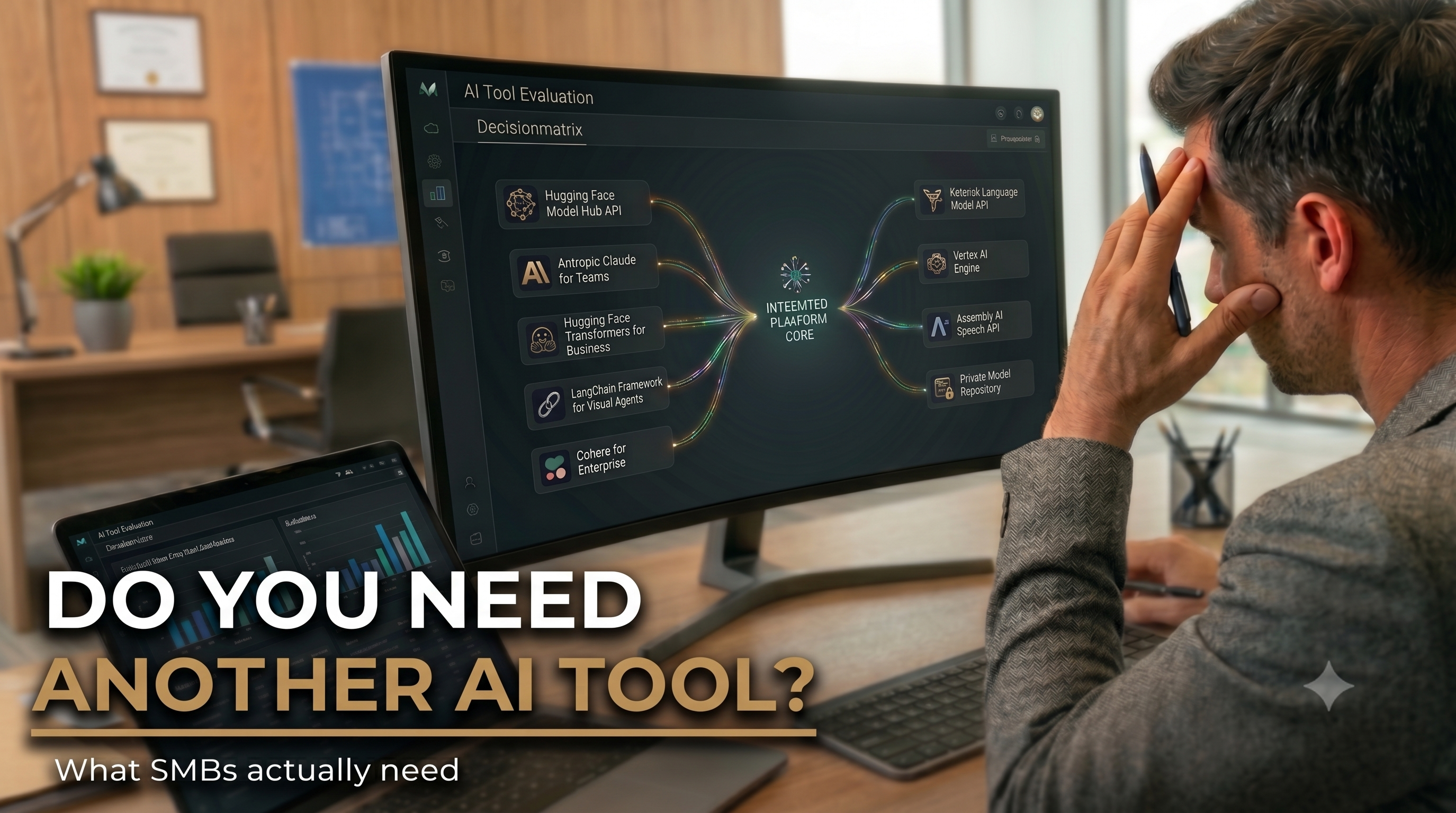
Buying another AI tool feels like progress. Most of the time it means you added one more subscription to a workflow that was already messy.
That's the pattern I keep seeing in SMBs right now. The team buys a writing tool, a chatbot tool, a meeting tool, an automation tool, maybe an agent tool on top of that. The demos look sharp. The trial goes well. Then the real business shows up. Data is inconsistent. Nobody owns the workflow. The approvals are fuzzy. The CRM is half-right. The reporting is manual. The tool didn't fail. The operating system around it did.
That's why so many AI investments stall after the excitement phase.
The numbers back up what I keep seeing. 47% of SMBs name data readiness as their top AI barrier. Another 37% say a skills gap is slowing them down (AWS/Techaisle, May 2026). The market is full of tools. What's scarce is the people, process, and governance to turn those tools into repeatable operating value.
Buying Tools Won't Build Capability#
A point solution helps with a task. The bigger jobs sit upstream: deciding which workflow matters most. Cleaning up handoffs between marketing, sales, ops, and service. Forcing accountability when the output is wrong, slow, or unusable. Building adoption across a team that already has too many systems and not enough time. That work belongs to people, and somebody has to own it.
This is the real divide between buying software and building capability.
Point tools are useful when the job is a single, well-defined task. A fractional AI team is an outside crew of people who own the workflow for you. It earns its keep when the workflow is still fuzzy. When priorities are competing. When scattered use cases need to become one operating plan.
That's the gap too many SMBs miss. They compare license cost to service cost and think they're making a smart financial decision. The smarter comparison is wasted license spend versus deployed value. Zylo's 2026 SaaS Management Index found the average organization leaves 36% of its SaaS licenses unused. A percentage like that doesn't care about company size. A 40-person company carrying five overlapping AI subscriptions leaks the same way, just with fewer zeros.
A tool is cheaper on paper. A team is cheaper in the real world if it helps you avoid six months of drift.
Here's the practical way I'd evaluate platform versus team.
1. Start with the workflow#
If a vendor starts by showing features before helping you define the workflow, be careful.
I ask every new client the same first question: where does money, time, or trust leak in the current process?
Lead response lag. Proposal turnaround. Sales follow-up. Content production. Reporting reconciliation. Intake and qualification. Customer support triage.
Serious AI work starts there.
If you can't point to the workflow owner, the bottleneck, the current baseline, and the KPI you want to move, you're still defining the job. Evaluate tools after that.
That's where a sprint comes first.
A sprint should identify the use case, map the workflow, expose the handoff failures, and define what success looks like. It gives the business a real operating target instead of a vague "we need AI" mandate.
A home services company we work with was filling out permit applications by hand. About 20 minutes each, every time a technician needed one. We didn't hand them a tool. We built the workflow into the system they already use, so the applications now file themselves. The tool was never the point. Owning the workflow was.
2. Price the full operating burden#
Most SMBs underestimate the hidden cost of point solutions. The monthly fee is visible. The internal drag is not.
Who will implement it? Who will train the team? Who will rewrite prompts when the outputs degrade? Who will handle governance? Who will integrate it into the CRM, inbox, reporting stack, and approval flow? Who will monitor whether the workflow is actually improving?
If the answer is "somebody on the team will figure it out," that usually means nobody owns it.
That's how AI becomes shelfware. I see it every week.
A fractional AI team changes that equation because the core value is operating ownership. Someone is responsible for setup, prioritization, KPI tracking, optimization, and course correction. That's what turns AI from an experiment into a managed function.
3. Demand proof of operational improvement#
Don't ask whether the tool is impressive. Ask whether the workflow is better.
Are response times down? Is cycle time shorter? Are more leads converting? Are approvals faster? Is reporting cleaner? Is margin leakage lower? Is the team spending less time on manual coordination?
That's the scoreboard we use with clients.
A good fractional team should be able to tell you what moved, why it moved, and what gets optimized next. If the answer is vague, you're buying activity instead of outcomes.
Here's what happens once you run that scoreboard. "Tool or team" stops being the question.
The real sequence for most SMBs looks like this:
Run the sprint. Install operating discipline. Then decide which tools belong in the stack. Then keep optimizing.
The tool comes fourth. Not first. That ordering is the whole argument.
Isolated software gives you capability on a pricing page. Managed implementation gives you capability inside the business.
And that distinction matters a lot right now, because the AI tool market is getting more crowded by the week. Every roundup of "best AI tools for small business" proves the same thing: there's no shortage of options. The shortage is operational capacity to choose the right use case, integrate the tool into real workflows, govern the output, and keep improving after launch.
Enough AI theater. SMBs need fewer disconnected tools, clearer ownership, and faster movement from pilot to production.
That's what a fractional AI team is supposed to solve: making sure the software you already bought finally does useful work.
If you're staring at a stack of AI subscriptions and can't say which one is moving a KPI, that's worth a conversation before you buy anything else. Reach out. Twenty minutes is usually enough to tell whether you need another tool or an operating plan.
Sources: AWS / Techaisle, "From pilot to production: How SMBs are winning in the AI era" (May 2026), https://aws.amazon.com/smart-business/resources-for-smb/techaisle-ai-adoption/; Zylo, 2026 SaaS Management Index (2026), https://zylo.com/news/2026-saas-management-index